
Detect Unit
Technology, Innovation and Expertise
De-Tect Unit Inspection is a specialist Non-Destructive Testing (NDT), inspection, and asset integrity company with more than four decades of experience across some of the most demanding industrial environments. Operating across sectors including power generation, nuclear, petrochemical, mining, oil and gas, and heavy industry, De-Tect combines highly specialised technical expertise with advanced inspection technologies to help organisations assess the condition, safety, and integrity of critical infrastructure.
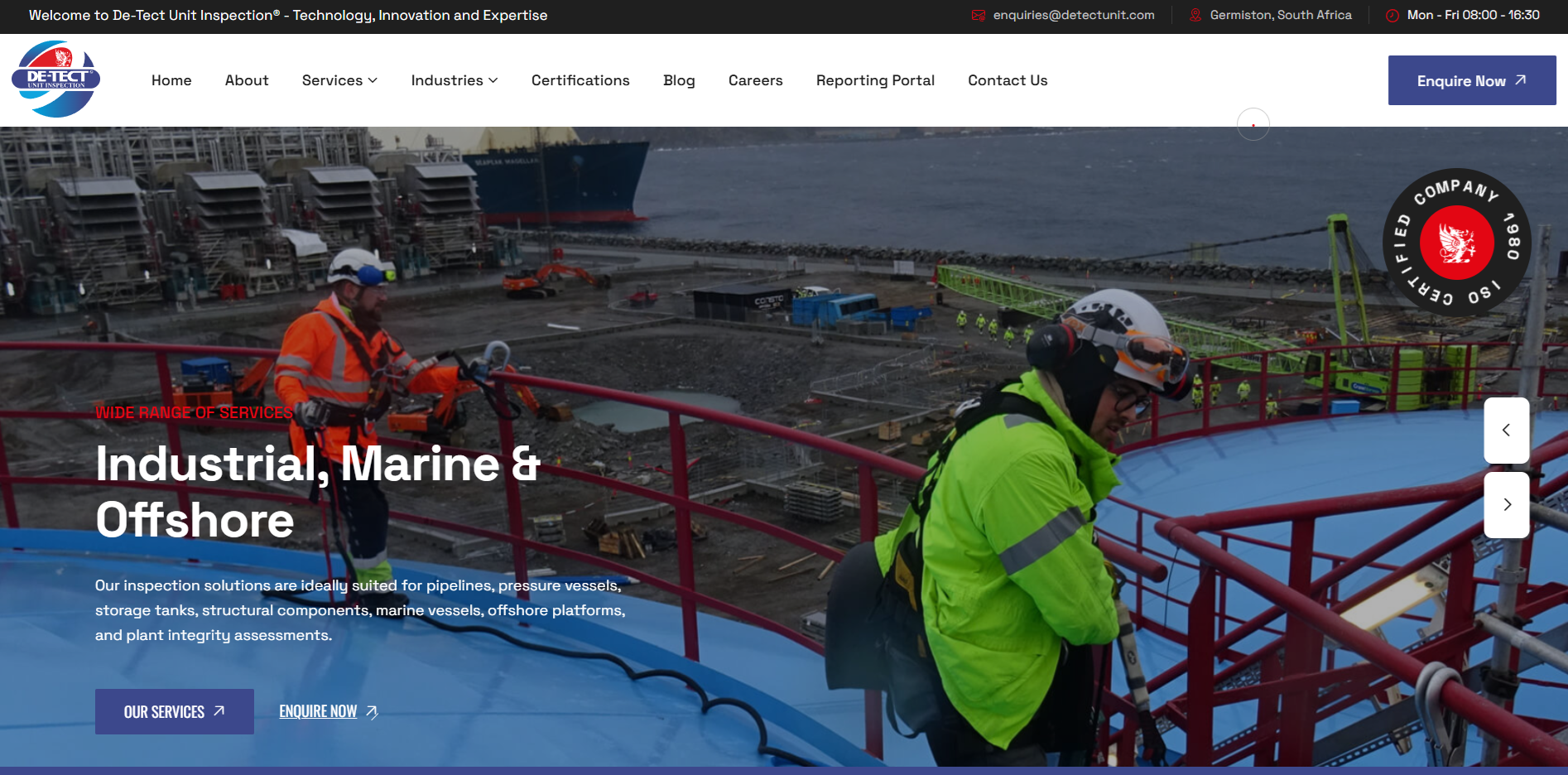
Teruza worked with De-Tect to translate that depth of technical capability into a modern digital presence that is clear, credible, and straightforward to navigate. The challenge was not simply to present a large catalogue of services, but to create an information architecture capable of communicating complex inspection methods to different audiences — from engineers and technical specialists to procurement teams, project managers, and prospective clients evaluating De-Tect's capabilities.
The platform structures De-Tect's extensive service offering across both conventional and advanced NDT disciplines, including radiographic and digital radiographic inspection, ultrasonic testing, phased array ultrasonic testing, eddy current inspection, corrosion mapping, magnetic flux leakage, tank floor testing, and specialist corrosion detection technologies. Services are supported by industry-specific content that provides context around how these capabilities are applied across nuclear facilities, power stations, petrochemical plants, mines, pipelines, tanks, and other critical industrial assets.
A major focus of the project was establishing a clearer relationship between De-Tect's services, industries, technical expertise, and operational history. Rather than presenting these as isolated pages, the website creates a broader picture of the organisation: a company founded in 1980 with decades of project experience, internationally deployed inspection capabilities, multiple operational locations, and the accreditations required to work in highly regulated environments. This gives prospective clients a way to move from understanding an individual inspection technique to understanding the experience and organisational capability behind it.
The digital experience was designed around clarity and scalability. A structured content system allows individual technologies, industries, technical documentation, company information, and future project content to be organised consistently while remaining manageable as the organisation expands its service portfolio. The responsive interface and strong information hierarchy are particularly important for a business where visitors may arrive looking for one highly specific inspection capability and need to establish technical suitability and credibility quickly.
The result is a digital platform that reflects the scale and technical maturity of De-Tect's physical operations. It turns a complex industrial service offering into a structured, accessible experience while providing the company with a stronger foundation for communicating its expertise internationally. The De-Tect project demonstrates how Teruza approaches specialised B2B platforms: understanding the underlying business and technical subject matter first, then building the digital structure required to communicate that expertise effectively.
Visit This Project Visit This Project“With a company like De-Tect, the challenge is information architecture as much as visual design. They have decades of experience, highly specialised technologies, and an enormous amount of technical knowledge. Our job is to structure that complexity so that someone can arrive looking for a specific capability, understand what De-Tect does, establish trust, and find the information they need without having to understand the entire NDT industry first.”
— Ardi Coetzee, CTO, Teruza
Our Services
We Offer These & More


AI
analytics
forex
chatbots
prospecting
Reach out by submitting
the form below
Contact Information
Whether you are looking for a full-scale system or quick advice, we are always happy to help.
Reach out. We will make it worth your time.
Phone
Let's Talk
Ready to chat? Click the button below to book a time that suits you.
Book A Call Book A CallWe work with world famous
brands and partners


